A client sits in my office. They are not here because life is hard. They are here because life has become flat. Colorless. Heavy. Each day feels like walking through water.
They describe depression in familiar ways: exhaustion, hopelessness, a sense of being stuck. But as I listen, I am observing something else. Something beneath the words.
I am watching their eyes.
The Minds Eye of Depression
In my years of practice, I’ve learned that the body speaks louder than words. And the eyes? They tell the whole story.
What I observe in clients experiencing depression is a specific pattern: they are locked in visual recall of past unresourceful constructs. Losses. Failures. Rejections. Moments of shame or powerlessness. These memories are not merely remembered—they are active. They are playing on an internal screen, often without the client’s conscious awareness.
Even when I gently guide the conversation toward possibilities—toward a future that could be different, better, lighter—something striking happens.
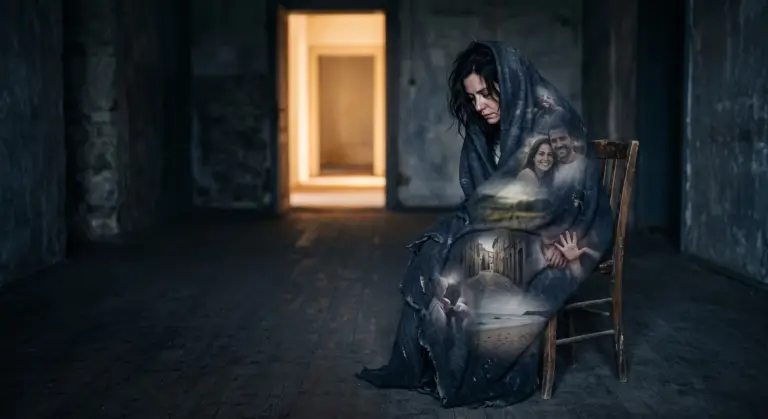
The client tries. I can see them attempting to imagine a different future. But here’s what I notice: they are attempting to lay the future over the past like a blanket. The new image doesn’t replace the old one. It simply covers it, thinly. The past is still there, pressing up from beneath, distorting the shape of what could be.
Depression, in this light, is not a chemical imbalance or a character flaw. It is a visual entrapment. The mind’s eye is fixed on what was lost, what went wrong, what cannot be changed. And every attempt to look forward is smothered by the weight of what already happened.
The Body Speaks Louder Than Words
I don’t need a client to describe their depression in perfect detail. I just need to watch them.
Their body language tells me:
- The slumped shoulders that say “I’m carrying something too heavy.”
- The shallow breathing that says “I don’t have room for more.”
- The downcast gaze that says “I cannot bear to look up.”
And the eyes—always the eyes. When I ask about the future, I observe their eye movements. Are they visually constructing (up and to the right)? Or are they visually recalling (up and to the left)—pulling up old images and trying to pass them off as possibilities?
More often than not, I see the latter. The past is not just remembered. It is re-lived. And it is projected forward, coloring everything that hasn’t happened yet with the gray of what already has.
The Shift: When Peace Arrives
So what does the turning point look like?
I’ve witnessed it hundreds of times. It doesn’t arrive with a loud revelation or a dramatic breakthrough. It arrives quietly.
When the shift happens, there is an immediate sense of peace. Not euphoria. Not manic energy. Just… peace. A stillness that wasn’t there before.
The body changes first. The shoulders drop. The breathing deepens. The jaw unclenches. And the eyes—they soften. They stop their frantic searching. They rest.
What I see in that moment is a new, focused individual. Someone who is no longer fighting the past or trying to outrun it. Someone who is simply… present. Ready to experience that peace in the here and now. And, for the first time in a long time, ready to carry it forward into their future.
The future is no longer a blanket-covered past. It is open. It is theirs to construct.
A Gentle Invitation for You
If you are reading this and you recognize yourself in these words, I want you to know something:
Depression is not your fault. It is not a failure of character or willpower. It is a pattern—a visual, neurological pattern—that has become stuck. And patterns can be un-stuck.
The past you carry may feel like a blanket you cannot remove. But the blanket is not you. It is something you have been wearing for so long that you forgot it wasn’t part of your skin.
There is a way to lift it. Not by fighting it. Not by pretending it isn’t there. But by gently, patiently, allowing your mind’s eye to turn toward something new. Something that hasn’t happened yet. Something that is waiting to be constructed.
The shift doesn’t require you to forget the past. It only asks you to stop using it as the blueprint for your future.
Peace is not something you earn. It is something you allow.
